Event
A Card Game Made by Hand
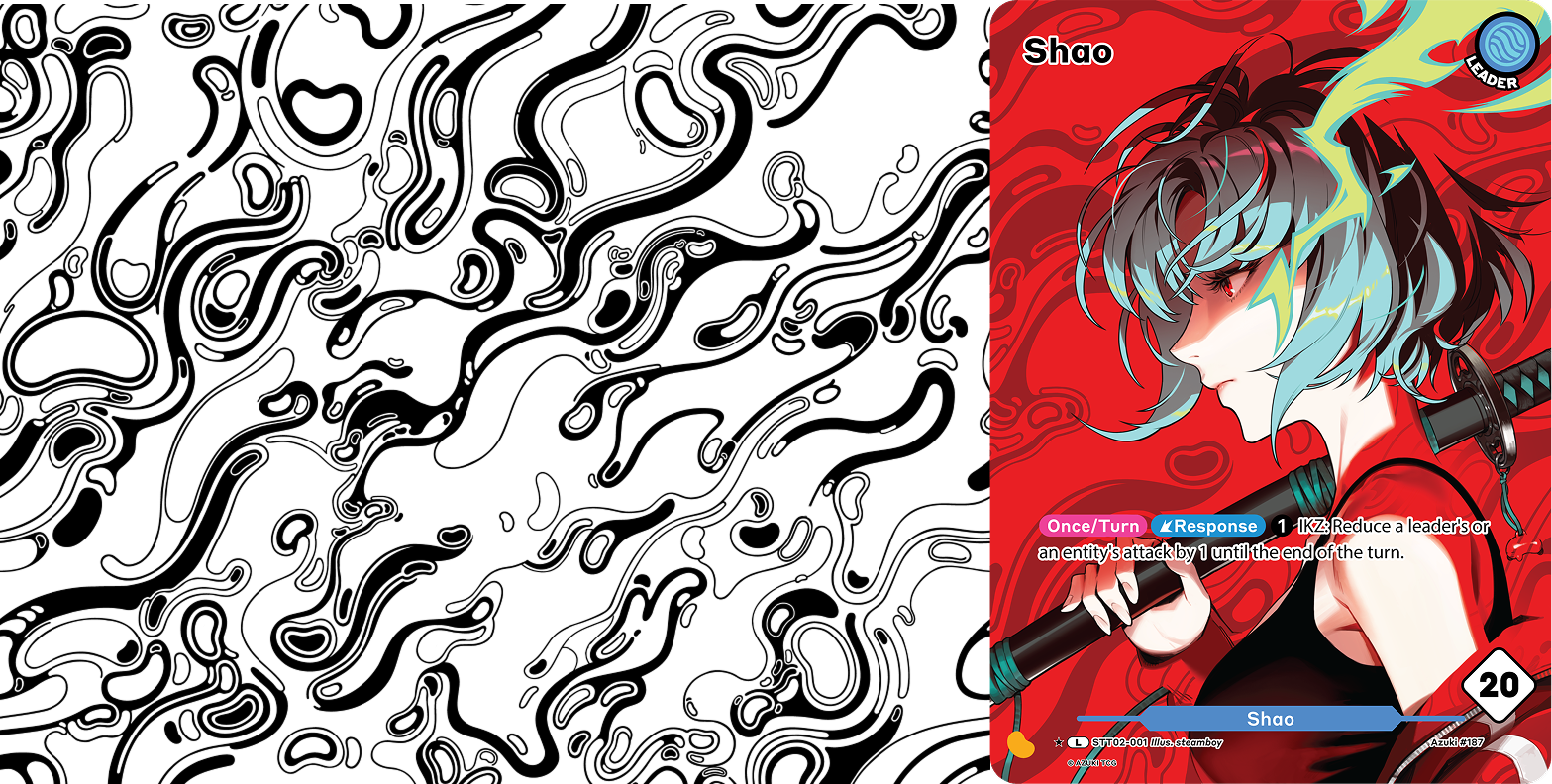
The bean foil is a pattern the Azuki TCG team designed from scratch for the Portrait Rare cards. It captures the moment of portal travel, the transient state when you cross from the Alley to the Garden with energy flowing around you.
Months of print testing went into getting that one effect right. The layer files stack CMYK, holo foil masks, UV gloss, cast & cure, and screen printing onto a single piece. A full set has around 200 cards and takes the team five to six months from start to printer. In this article, we get an in-depth look at the art process with the Azuki TCG team.
Tim & The Team
Tim is the creative director for Azuki TCG. His background runs through industrial design, theme park design, and Blizzard's Overwatch concept art team. He joined Azuki as an artist, and the TCG started as a passion project.
"What I do on the job these days is bridge the world building, the art aspect of Azuki from its IP and from the manga that's being developed. Take all those story moments, take all the cool characters and bridge that with the fun gameplay that people get to experience in the TCG, and make sure it comes out as a beautiful print that collectors will love to touch and feel in their hand."
Magic was Tim's first TCG, and as a kid he also collected Pokemon and Dragon Ball cards. He's always been passionate about making TCGs of his own. At home, he builds simple card games to play with his daughter, sometimes letting her draw the artwork or shape the rules.
In the early days of the TCG, Tim was leaning on Arn, also known as Steamboy. Together, they explored which characters, themes, and card types belonged in the experience, drawing from years of Azuki lore and world building to establish the visual and narrative foundation of the first set of cards.
When gameplay development began, Tim worked closely with Jon, the game director, to define the many categories of card art the game required, with gameplay shaping the visual needs of each card category. At the same time, the gameplay itself was deeply influenced by Azuki’s worldbuilding, with mechanics designed to feel distinct to the duality of the alley and garden world while showcasing themes of the elemental domains. Each element’s playstyle drew from the identity, culture, and characteristics of its respective domain, allowing the gameplay and visuals to find cohesion.
In the earliest days, the internal art team carried it: Andrew, Sky, Kang, Ryder, and Sam, with everyone pitching in. As the gameplay expanded and the card pool grew into the hundreds, Tim brought in outsource studios and contract artists across the industry. Contractors get a brief from Tim that includes the template and style guidelines for line art and coloring. Holding the visual style together across so many artists is one of the harder parts of the job.
Most TCGs have one core visual focus: Hearthstone comes from Warcraft, One Piece has its established IP, Magic leans fantasy. Azuki is still building its IP.
"We're also unique in that our visuals feel very multi-dimensional."
The foundation comes from Arn's East-meets-West style. Layered on top of that is the world structure of Azuki itself. The Alley world is contemporary, grounded in everyday life. The Garden world is fantasy, blending feudal Japan with Western fantasy. Inside the Garden are the four domains, each tied to an element, with its own visual flavor.
The Process
The team’s philosophy is gameplay first. Every card begins with a mechanic, and the visuals are made to reinforce and express that gameplay. Rather than slapping any artwork on a card, each illustration is meant to capture the action and feeling of the card itself. Silver Current Haruhi, for example, her card ability deals additional damage when she launches an attack, so the illustration shows her mid-kick, releasing a burst of silver lightning as she demonstrates the technique to her students. Likewise, when designing a root effect, the team might portray a massive python coiling around its target instead of interpreting the mechanic too literally. The goal is always to match gameplay with visuals that feel flavorful, immersive, and true to the world of Azuki.
Once the concept is set, Tim writes a brief. It includes the gameplay, a rough description, and references for character art, pose, lighting, color, and background.
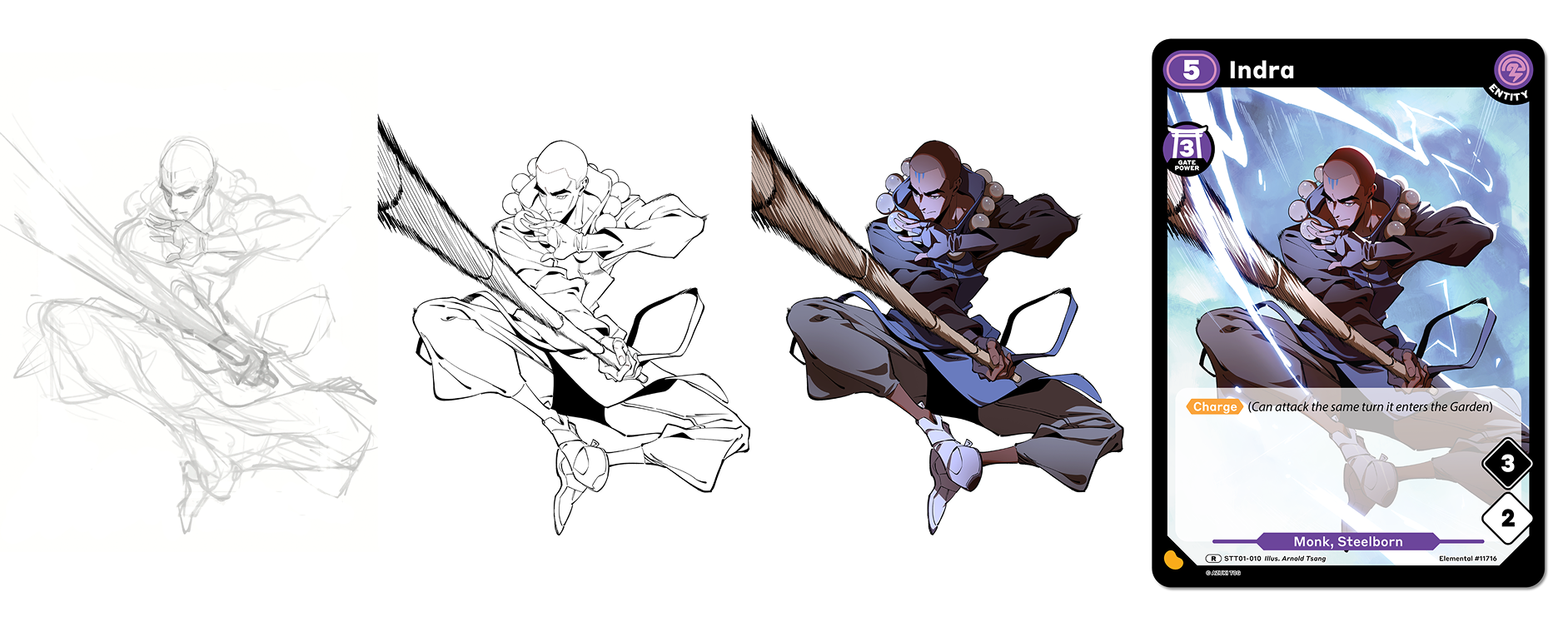
Every card starts as line art. The line art establishes character, pose, anatomy, and composition before any color or lighting is applied. Azuki style is line art driven and cel-shaded in an anime style. The team aims for 70 to 80 percent of the art to hold this look. The rest leaves room for artists to bring their own voice, which is why alt arts and chase cards can have a different look visual style from the rest of the collection. Tim does an approval pass on the line art to see how well it captures the core concept. The team wants it clean, with forms, perspective, and anatomy as correct as they can be while staying true to the IP. Once approved, the artist moves to base color, then lighting and rendering.
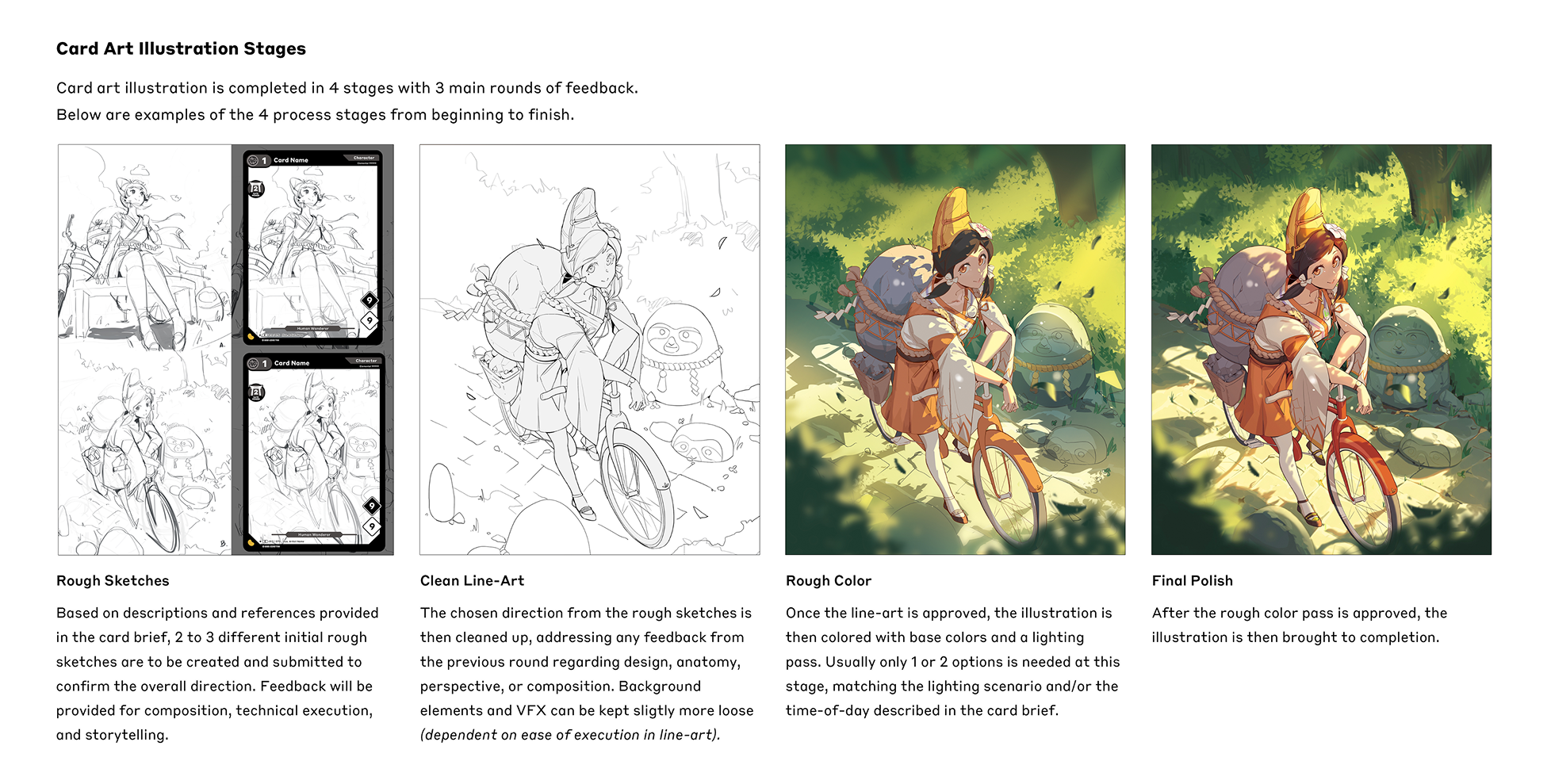
Many illustrators are not accustomed to creating artwork specifically for print production. An illustration seen on the screen can look rather differently once printed. Color is one of the common challenges, as many tones will appear much more saturated on a monitor. Part of Tim’s role is reviewing artwork through a production lens, catching those issues early and working with artists to make adjustments.
Every piece of artwork passes through Tim.
"Every day I might get anywhere from 3 or 4 to maybe like 15 to 20 different pieces that are updated. I need to review each piece and provide feedback or paint-overs, often within the same day, to keep pace with the production schedule."
He goes through each one, checking quality, anatomy, perspective, likeness to existing characters, scale, color vibrancy under print conditions, and layer cleanliness. When he can't cover it all, he asks Arn or someone from the art team for help.
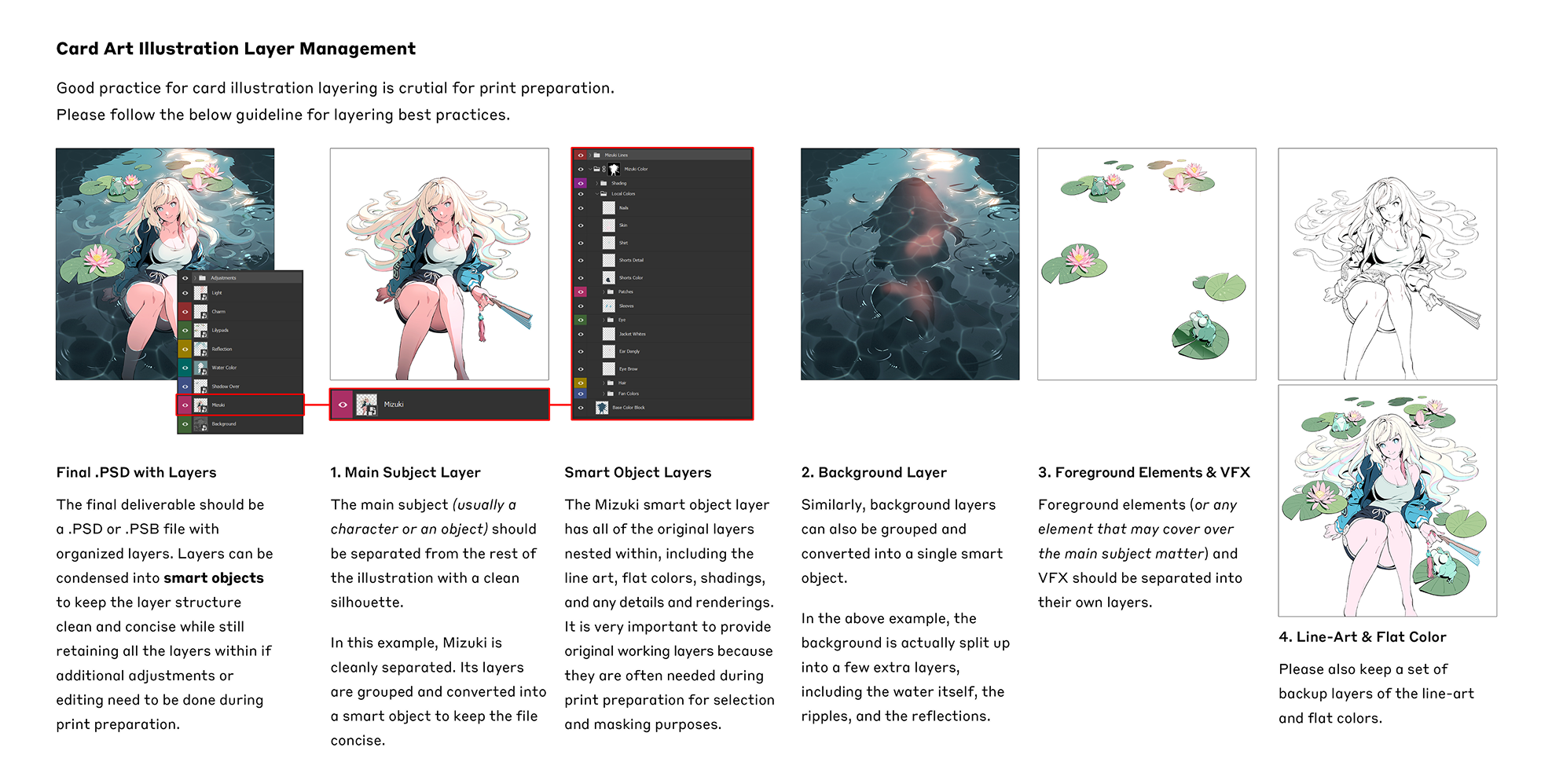
Once the art is done, the file goes through a final layer check. Azuki cards have specific guidelines for layer separation: foreground, middle ground, background, character, and VFX, each on its own layer. If a character is partly mixed with the background or some layers are unclean, the team can't make clean masks, and the file may be bounced back to the artist for cleanup.
The team spent months talking to print shops, both domestically and overseas, getting test prints to see how the art would look. They learned the techniques behind building a card layer by layer to achieve the desired print effects and surface treatments.
"We spent months actually just talking to various different print shops, both domestically and overseas, just trying out different shops, getting test prints just to see how our art will look."
With these learnings, Tim worked with Ben, the production artist, to transform each layered illustration into a finalized production file ready for print. This process involved integrating the card frame, gameplay text, symbols, icons, and other visual elements needed to bring the artwork into its final playable form, detailed with the desired print treatments and surface finishes.
Each print-ready production file may include several layers of information:
- CMYK for the colors: cyan, magenta, yellow, and black
- A holo foil layer, generated from the artwork, that tells the printer where to lay down white ink to block out where the team doesn't want it to be foil
- Masks for effects and surface treatments, such as silk screened textures, reverse UV patterns, foil stamping, UV gloss, and any other unique effects
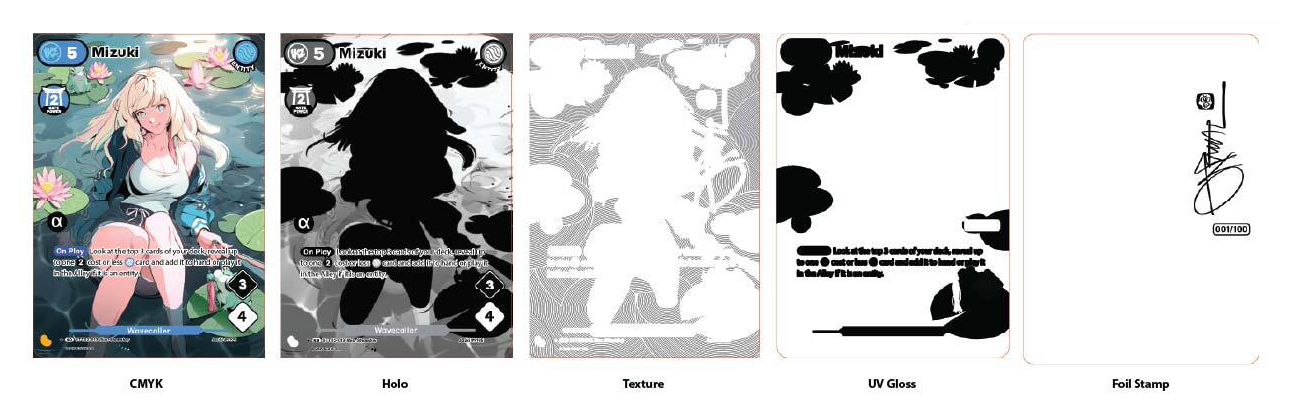
The production file is sent to the printer, who returns a proof showing how they've mapped each layer to a print technique on their machines. Once approved, the printer generates the plates from the layers, lays out the full set on sheets, and prints.
A set's art takes about three to four months from start to finish. With planning, names, flavor text, and briefs on the front end, the full pipeline runs five to six months per set. Set 1 has a little over 200 cards between starter decks and booster packs, and over a dozen different promo alt arts.
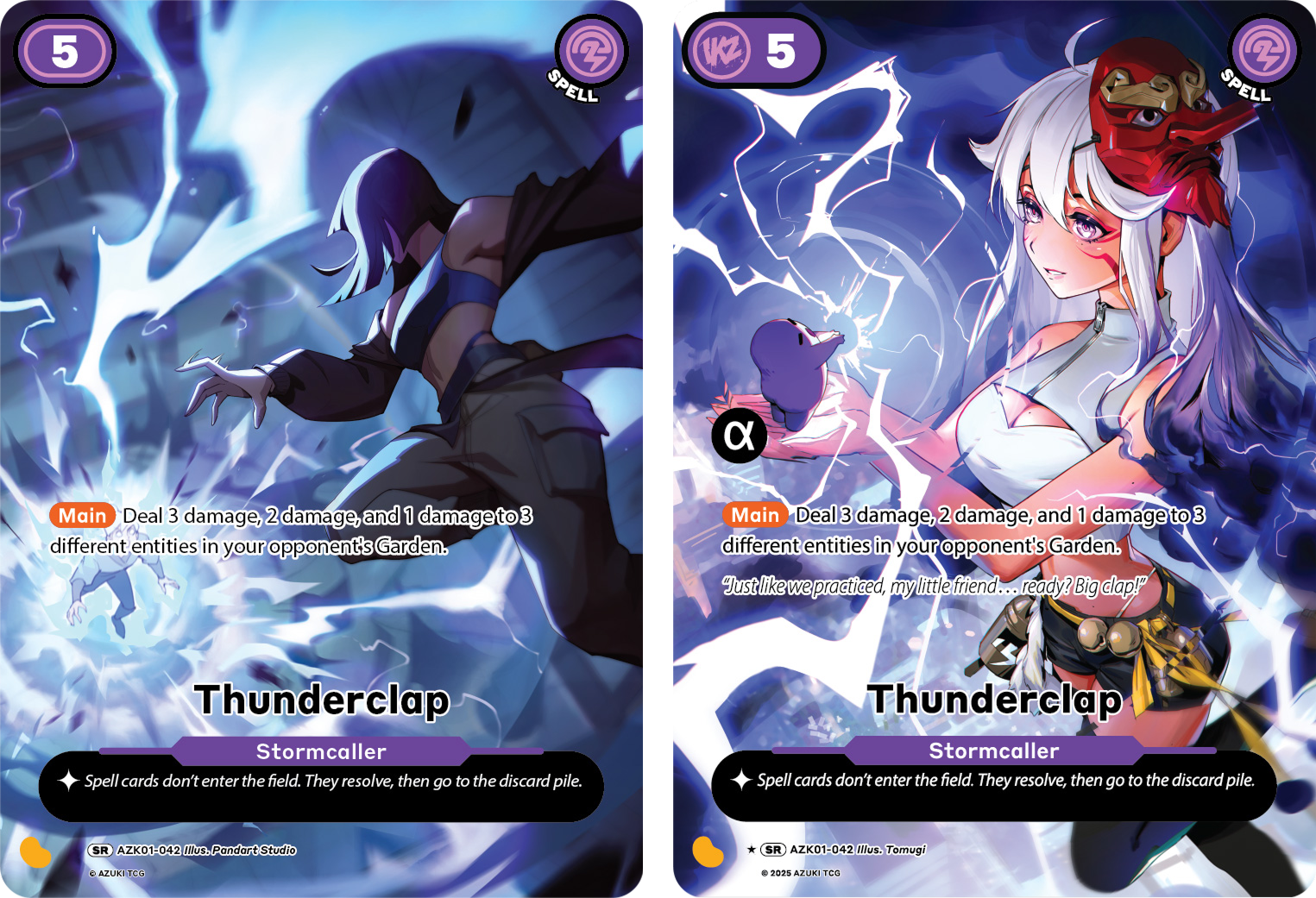
Alt-arts are where Tim has the most fun. With characters, the base art and the alt-art usually need to look the same. With spells, objects, and weapons, the base concept is looser, with more room to interpret. Tim worked on the alt-art for Thunderclap, a lightning spell that does damage. The alt-art leans into the name.
"How funny would it be if there's a little tiny bean character that does this little clap, but it makes this crazy big thunder shock."
The beanz character sits in the hand of a powerful goddess as she cheers him on, “Just like we practiced, my little friend…read? Big clap!”
What's Next
Tim's standard for Azuki TCG comes from his life as a player and collector. Even when he wasn't playing the game much, he bought cards to imagine the world they came from. He was never into D&D, but Magic's art sold him on it. The Japanese influence and Oni of the Kamigawa set, the vast plains with their clerics and paladins, the mighty angels and dragons, the otherworldly slivers and Eldrazi, all made him imagine a world he wanted to be a part of.
"It feels like each domain or each of the factions feel intentionally built that way, where there's the flavor and you can feel it in the card art itself."
That’s the bar for Azuki TCG. The card pool may still be growing, but over time the goal is for the artwork to gradually paint a broader picture of the world itself. Between the Alley and the Garden, there are countless stories, characters, and creatures waiting to be explored through future card illustrations.
Set 2 continues that expansion by introducing both familiar faces and entirely new characters, along with emerging factions, distinct cultures, and new looks of each elemental domain that showcase a wider range of tones and identities within the world of Azuki.
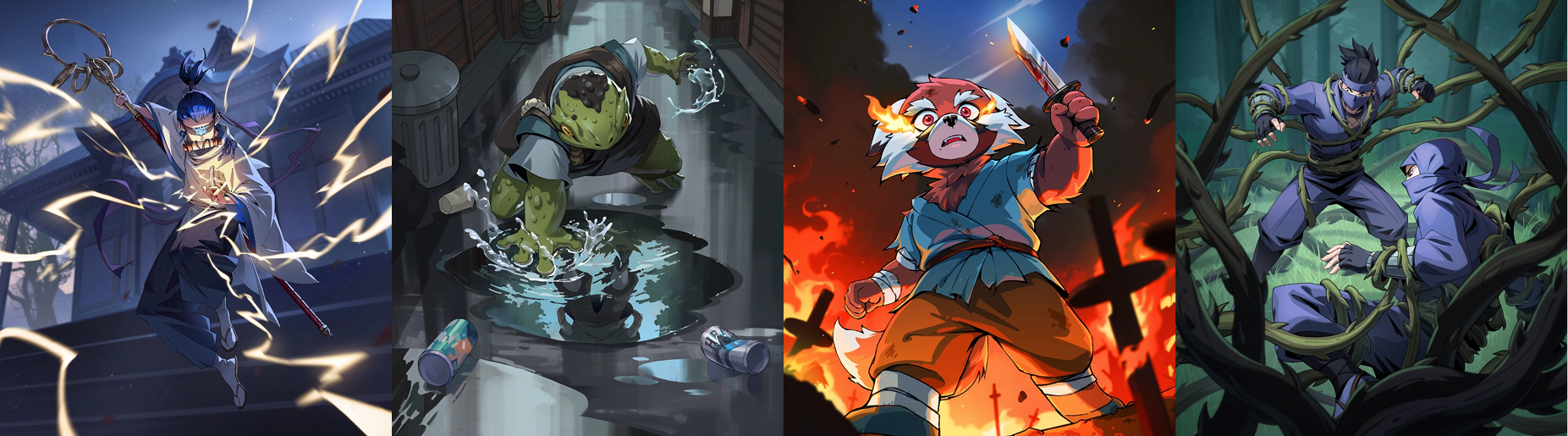
From the lightning domain’s Cloudreader monks seeking enlightenment through the skies, to the rain-soaked back alleys where opportunists thrive in conflict, to the blood-fueled fury of the fire domain and the earth domain’s groves that can both nourish and punish, each corner of the world brings its own flavor to the growing card pool.
These evolving themes naturally go hand in hand with new gameplay mechanics, allowing the worldbuilding, visuals, and game design to continue growing together. Set 2 already has more than 200 finished cards in the pipeline and will be coming towards the end of the year.
Download the Azuki TCG app for IOS here or on android here Follow @AzukiTCG on X for updates.